Quicklook
When building up your feed it can be difficult to know what the result of the mutations and rules will be. To help with this, we have a quicklook feature that allows you to see the final result of a field without having to inspect the final feed it self.
How to use it?
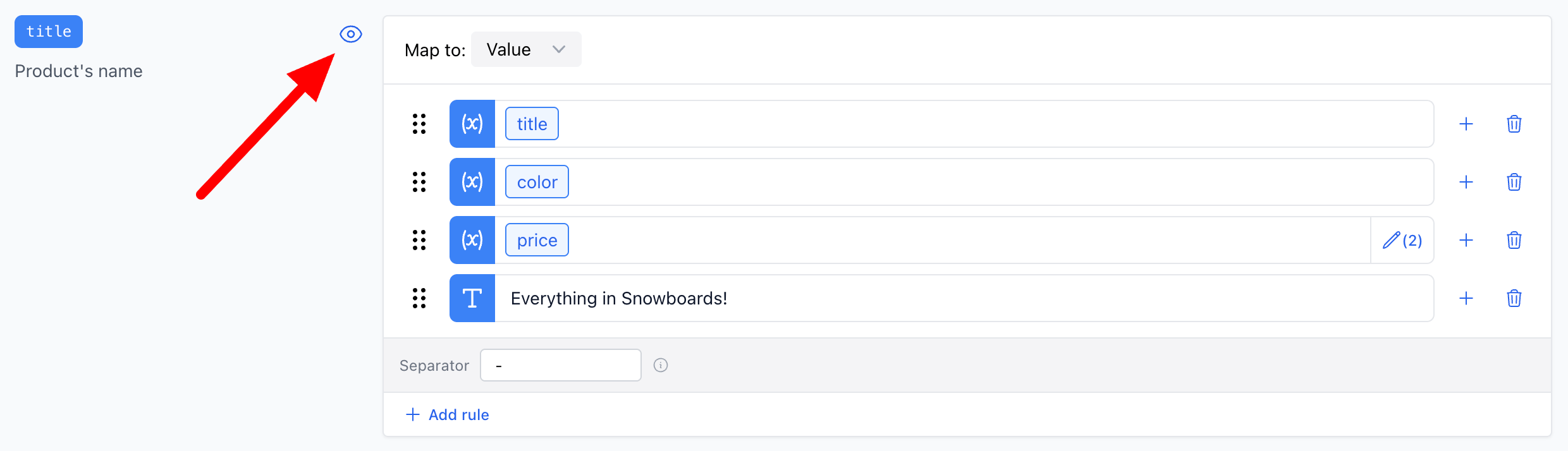
Let's take a look at the following example. Here we want to optimize our title by adding the title, color, price and some static text.
Based on the mapping it self, it can be difficult to know what the output will be. We have multiple fields that are combined, with mutations to some of them. Perhaps some items doesn't have a color, and are the spaces in the correct place?
To visualize the result, simply click on the eye icon next to the field you want to see the result of.
This will open a modal looking like this:
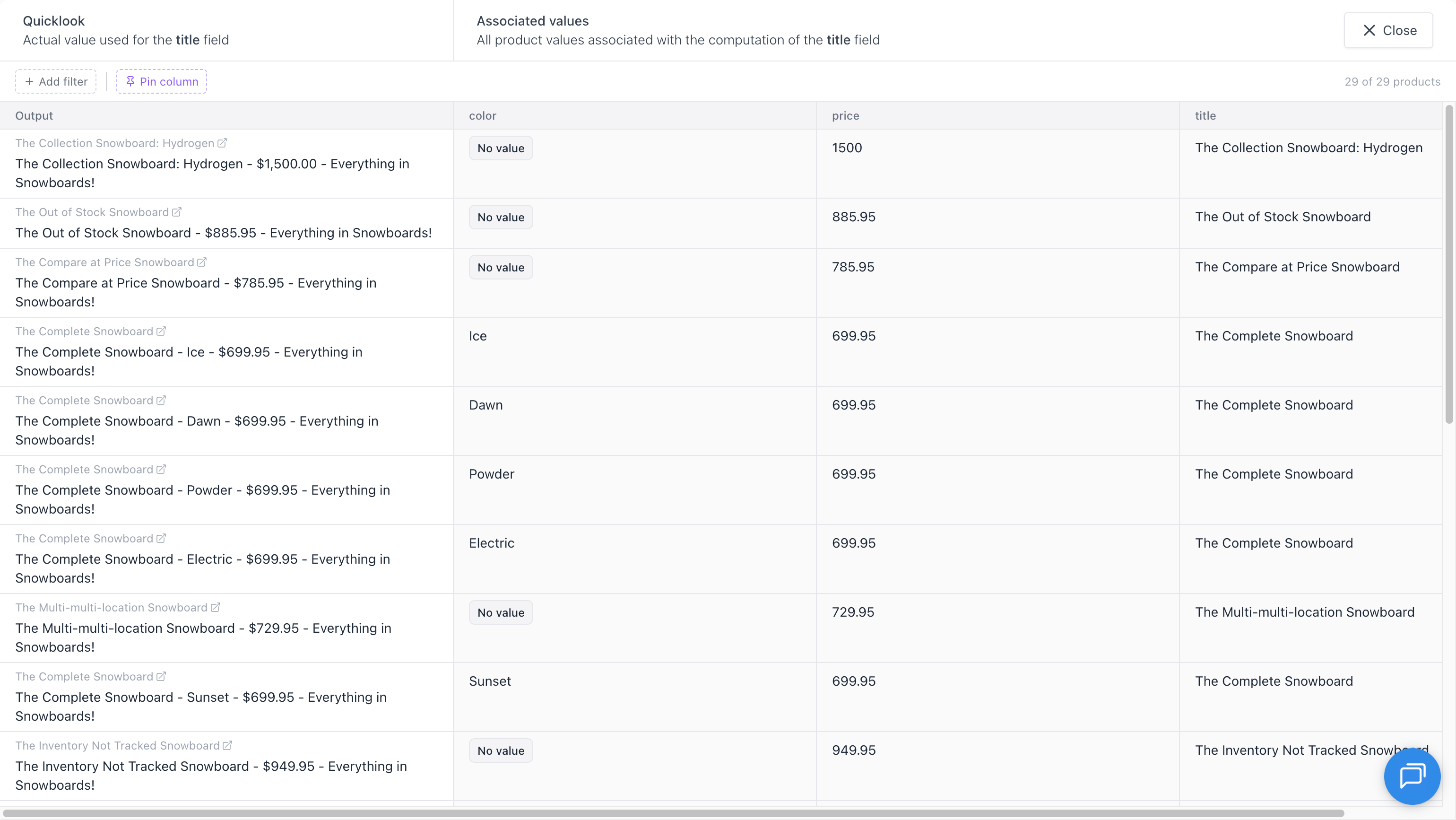
In the left column you can see the result of the field. The columns right of that contains all your dependencies, meaning all the values that goes into creating the final result.
In this example we can see that some of the products doesn't have a value for color. We can verify that the output still looks good. Maybe we want to add a default color? Who knows, that's up to you.
Filtering products
You can filter the products shown in the quicklook to find exactly what you're looking for. Instead of a simple text search, quicklook supports structured filters with different operators depending on the field type.
To add a filter, click the Add filter button in the toolbar. This opens a wizard where you pick a field, an operator, and a value.
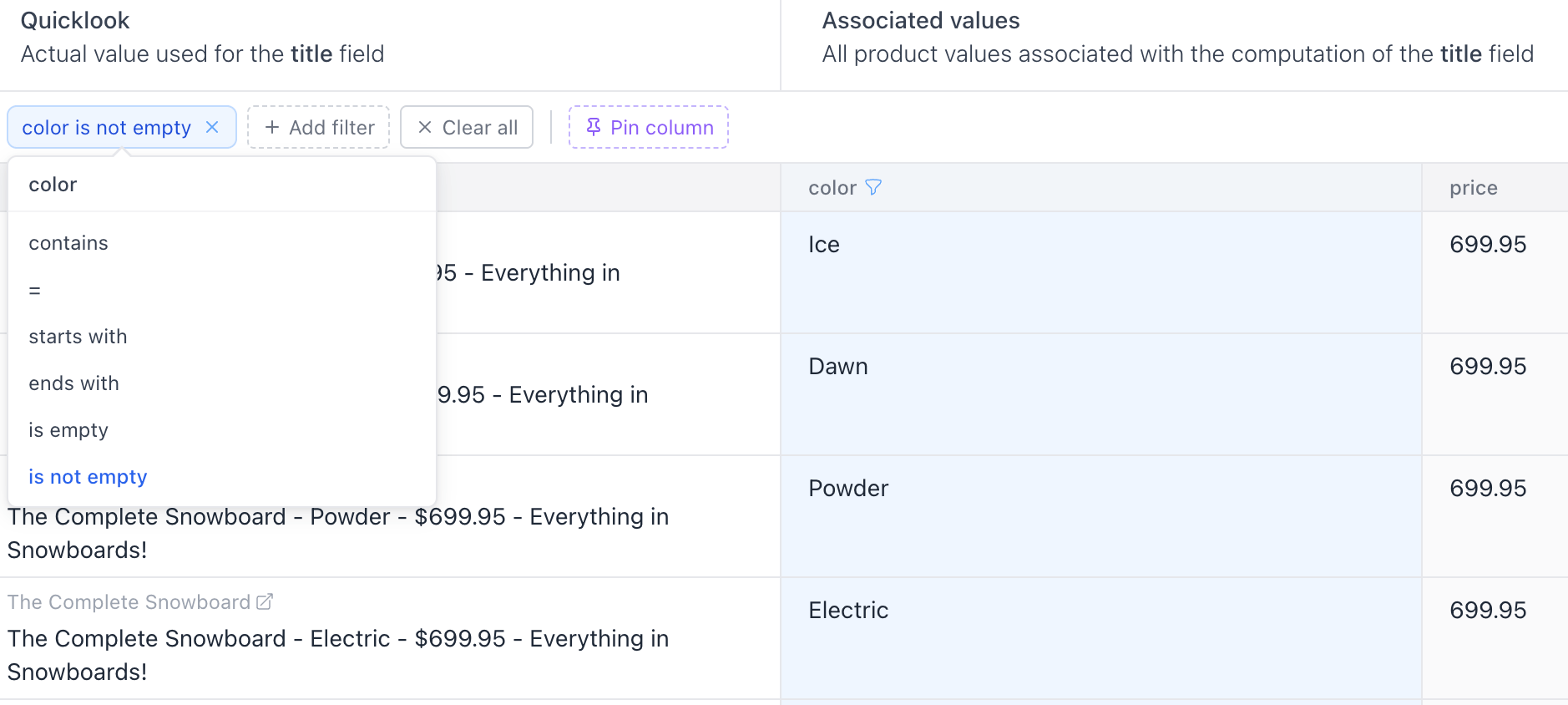
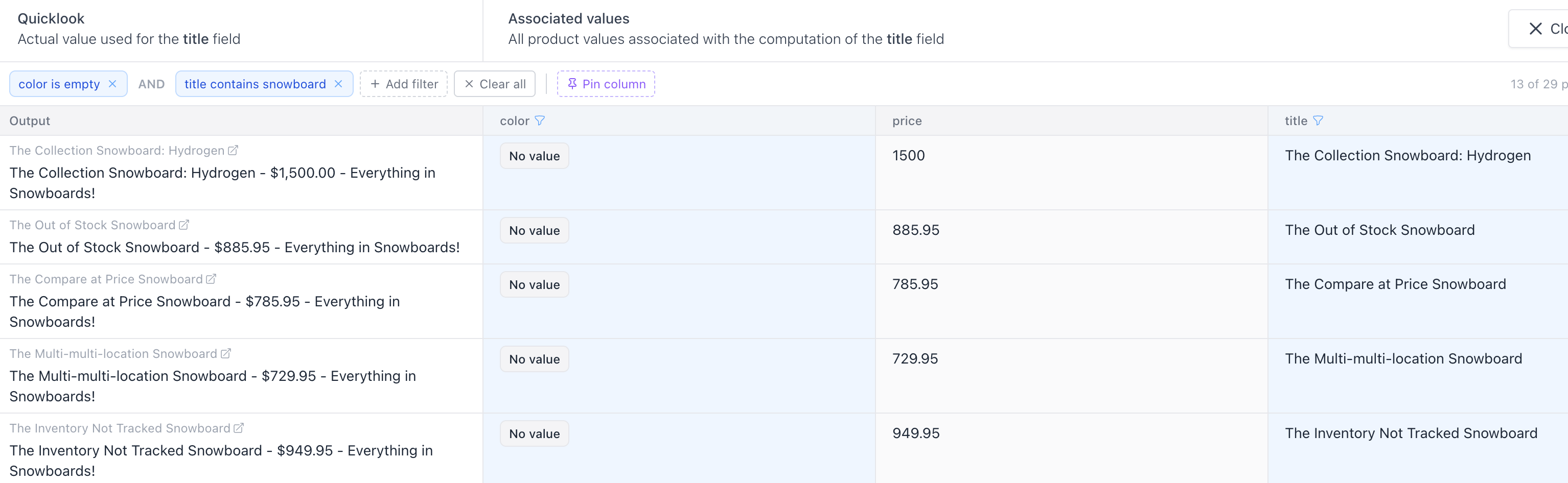
You can add multiple filters at the same time. When you have more than one filter, click the logic toggle between them to switch between AND (all filters must match) and OR (any filter must match).
The available operators depend on the field type:
- Text fields — contains, equals, starts with, ends with, is empty, is not empty
- Number fields — equals, greater than, less than, between, is empty, is not empty
- List fields — contains, is empty, is not empty
- Boolean fields — equals (true/false)
The toolbar also shows how many products match your filters out of the total, so you can see the impact of your filter at a glance.
Your filters are automatically saved per field, so they'll still be there when you reopen quicklook.
Pinning columns
By default, quicklook shows the output value and all its dependency columns. If you want to see additional product attributes — for instance to cross-reference the output against a field that isn't a direct dependency — you can pin columns.
Click the Pin column button in the toolbar and select the attribute you want to add. Pinned columns appear to the left of the dependency columns and are highlighted in purple so you can easily tell them apart.
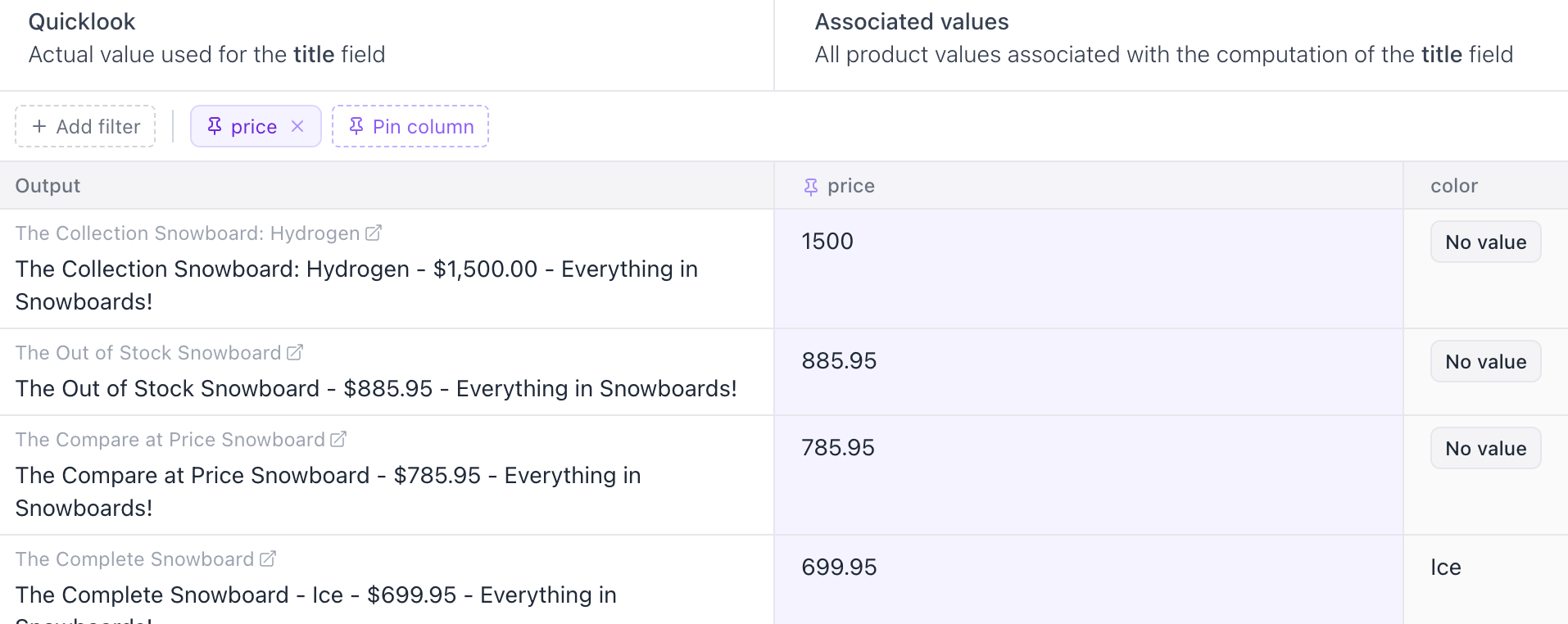
To remove a pinned column, click the pin icon on the column header or remove it from the toolbar. Just like filters, your pinned columns are saved per field.
Resizable columns
All columns in the quicklook table can be resized by dragging the edge of a column header. This is useful when a column contains long values like URLs or descriptions. Your column widths are saved so they persist across sessions.
Quicklook for Mutations
Since it can be a bit finicky to know what the result of a mutation will be, we have added a shortcut to the Quicklook modal straight from the mutation modal.
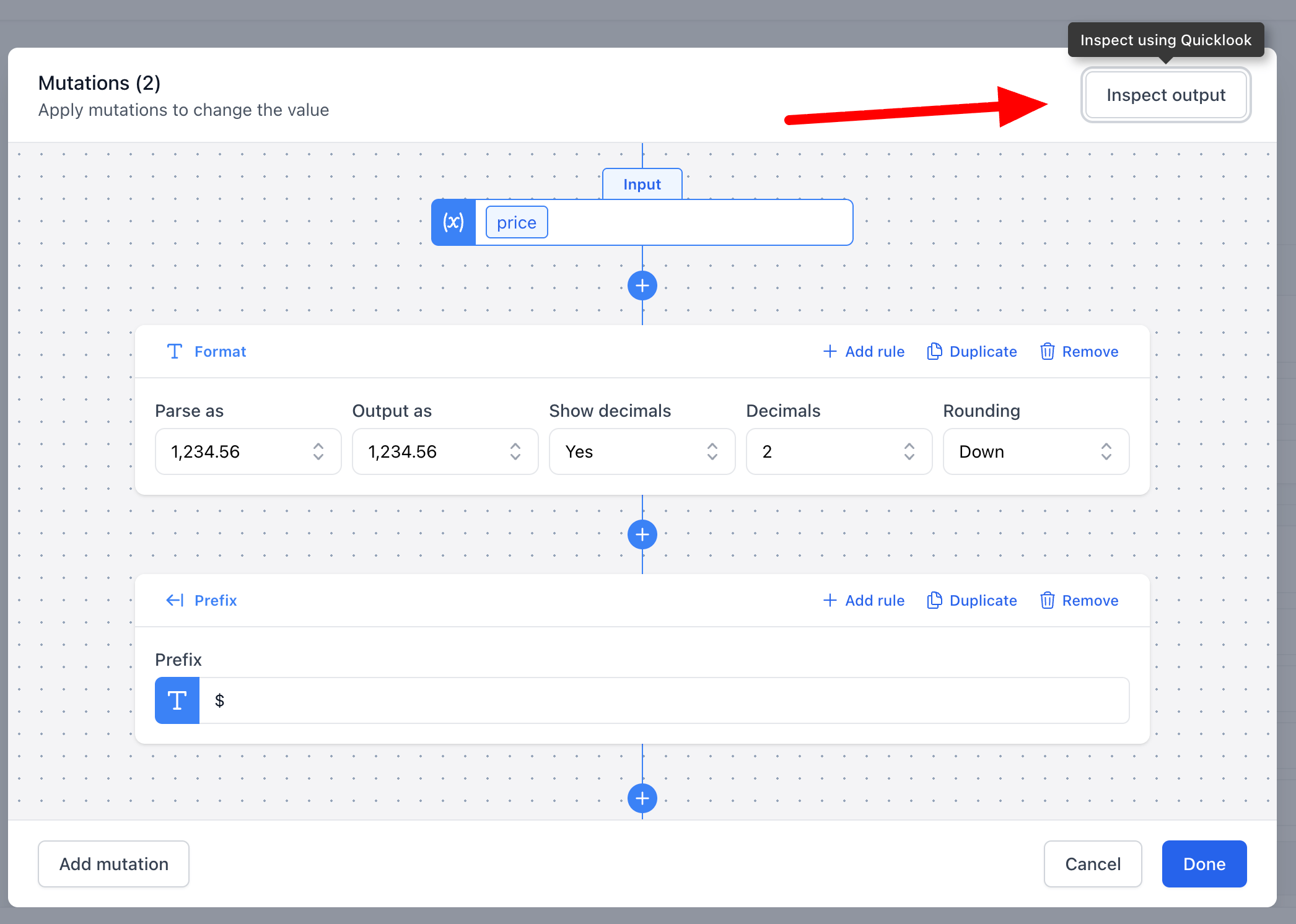
This allows you to quickly see the result of the mutation, without having to close the mutation modal every time you've made a change.